

Why Your Sauna Isn’t Getting Hot Enough
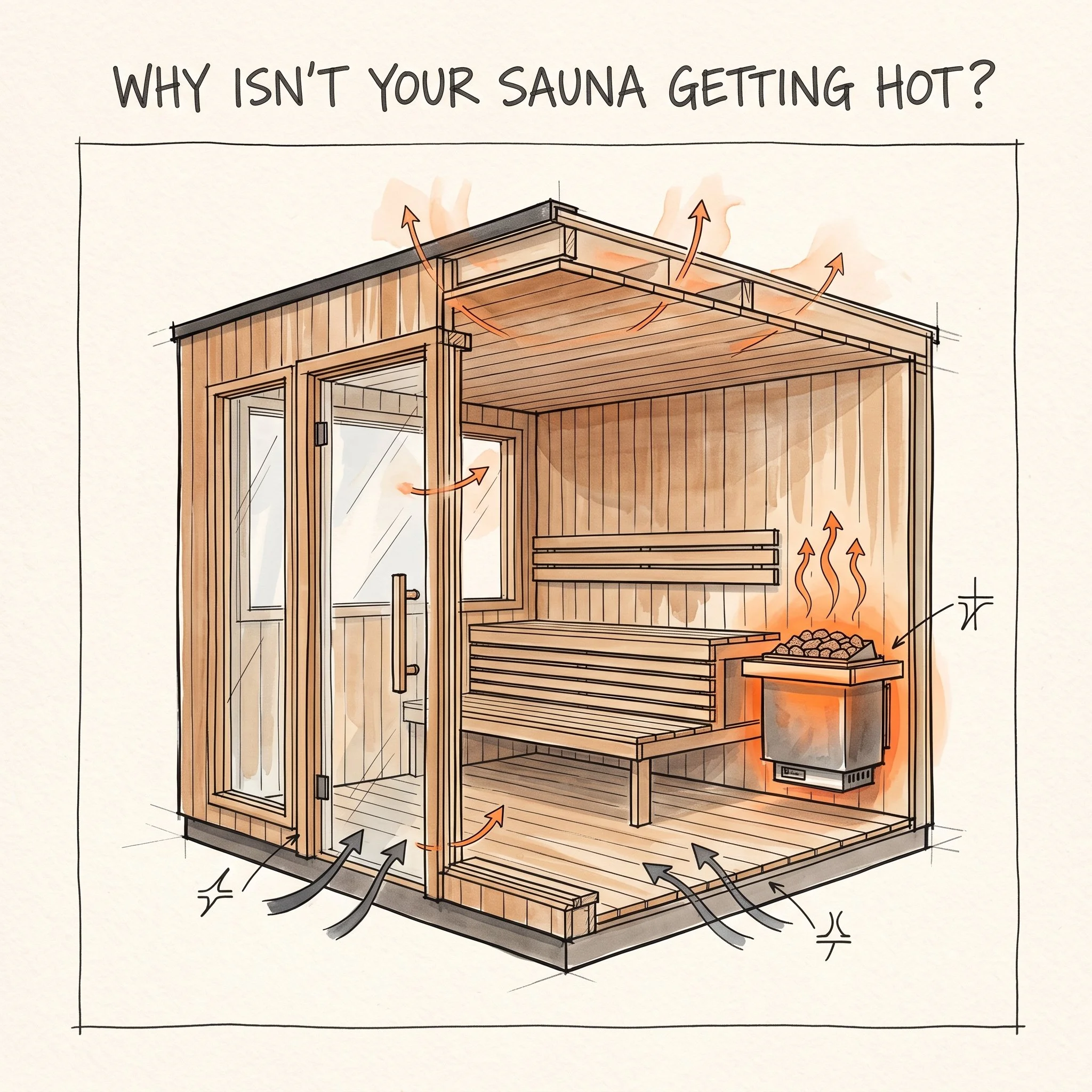
And Why the Way a Sauna Is Built Matters Just as Much as the Heater
A sauna should get hot.
Not eventually. Not only in July. Not after running the heater at full power for hours.
A properly designed sauna should heat predictably, hold temperature, produce good steam and continue performing when the weather outside turns brutally cold.
At Noble Saunas, that performance is one of the fundamental things we design around.
We don't think of a sauna as a wooden box with a heater inside it.
We build it as a complete thermal system.
The heater, insulation, vapour barrier, air sealing, ventilation, glass, doors, ceiling height, bench position and total room volume all work together. If one part of that system is badly designed, the entire sauna can suffer.
That's why two saunas that look almost identical in a photograph can perform completely differently once you actually turn them on.
One might reach temperature, hold it effortlessly and recover quickly after the door opens.
The other might run continuously and still leave you wondering:
Why isn't my sauna getting hot enough?
Here are the most common reasons—and many of them explain exactly why we build Noble Saunas the way we do.
1. Your Sauna Heater Is Too Small
This is the obvious place to start.
Every sauna heater has a room-volume range it is designed to heat.
If the room is too large for the heater, the heater may:
Run almost continuously
Take an extremely long time to reach temperature
Struggle in cold weather
Recover slowly after the door opens
Produce disappointing steam
Never reach the experience you expected
The first calculation is simple:
Interior Width × Interior Depth × Interior Height = Sauna Volume
Notice that we said interior dimensions.
That's important.
At Noble Saunas, our outdoor saunas have real wall assemblies containing framing, insulation, vapour barrier, an air space and interior and exterior finishes. The exterior footprint is therefore larger than the actual hot-room dimensions.
Heaters must be sized using the space they are actually heating.
If you're still deciding how large your sauna should be, read our Noble Journal guide:
It explains why we don't rely heavily on vague industry labels such as “4-person sauna” or “6-person sauna.” We design around actual bench space, real-world use and interior volume.
Noble Saunas Are Designed With the Heater From the Beginning
We don't finish the building and then ask:
“What heater can we fit in here?”
Heater capacity is considered while we are designing the sauna.
We look at:
Interior volume
Ceiling height
Glass area
Insulation
Outdoor exposure
Bench layout
Heater placement
Ventilation
Electrical requirements
Stone capacity
How the owner actually plans to use the sauna
That means the heater and the building are designed to work together.
If you're comparing electric and wood-fired options, we have a complete guide here:
Electric vs Wood-Fired Sauna Heaters
2. The Sauna Isn't Properly Insulated
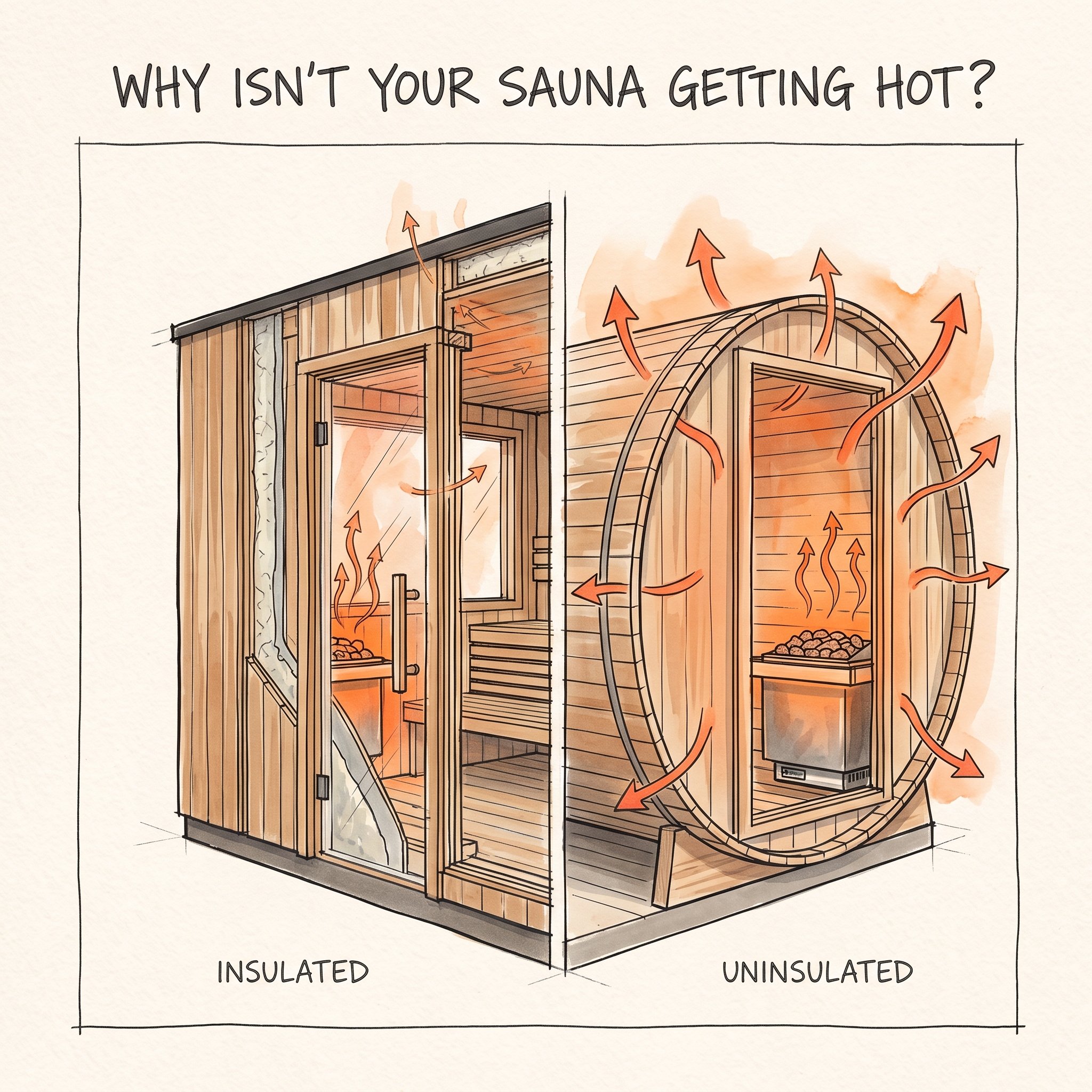
This is one of the biggest differences between Noble Saunas and many of the sauna products sold online.
There are a lot of beautiful-looking saunas on the market.
Barrels.
Thin-panel cubes.
Flat-pack kits.
Imported prefab rooms.
Some can absolutely get hot.
But getting hot is not the same thing as efficiently controlling heat.
A heater constantly adds energy to a sauna.
At exactly the same time, the building is constantly losing energy through:
Walls
Ceiling
Floor
Glass
Doors
Ventilation
Gaps and air leakage
A properly insulated sauna slows that heat loss.
An uninsulated structure forces the heater to fight it.
This Is Why We Insulate Noble Saunas
Our saunas are built much more like small buildings than lightweight sauna kits.
We use proper framed wall assemblies with insulation and a dedicated sauna vapour-barrier system.
Why?
Because we build for places like Calgary and the Canadian climate.
When it's deeply below freezing outside and you're trying to maintain sauna temperatures inside, there can be an enormous temperature difference between the two sides of that wall.
We want the heat inside the sauna.
Not heating your backyard.
We've written an entire Noble Journal article explaining this:
Why Insulation Matters in a Sauna
If you're deciding between an insulated custom sauna and a kit or prefab product, also read:
Custom-Built Noble Sauna VS. Prefabricated Kits
This isn't just a construction detail we like talking about.
It directly affects how the sauna performs every single time you use it.
3. Your Sauna Is Leaking Hot Air
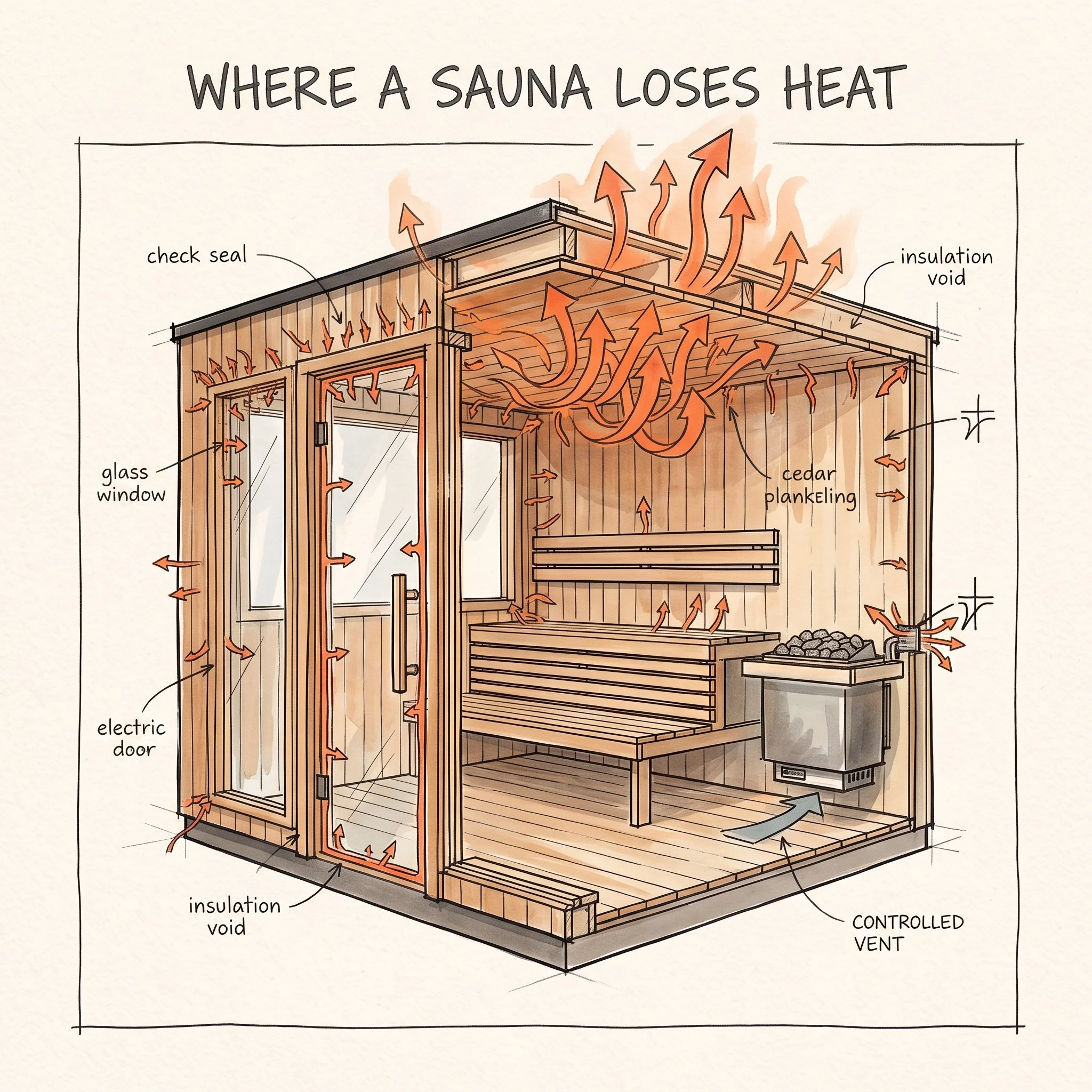
You can put insulation in a wall and still build a sauna that leaks.
That's why insulation alone isn't enough.
At Noble Saunas, we pay significant attention to creating a properly sealed hot-room envelope.
Potential air leakage can happen around:
Doors
Windows
Corners
Ceiling transitions
Wall joints
Electrical penetrations
Vent penetrations
Vapour-barrier seams
Every uncontrolled opening gives hot air somewhere to go.
A sauna needs ventilation.
But there is an important distinction between:
controlled ventilation
and
random holes in the building.
We want fresh air entering where we designed it to enter and exhaust leaving where we designed it to leave.
We don't want expensive heated air disappearing through poorly sealed construction.
This Is One of Those Details You Can't See in the Finished Photos
Once cedar is installed, you can't see the insulation.
You can't see most of the vapour barrier.
You can't see how carefully the penetrations were sealed.
And that's exactly why two finished saunas can look equally beautiful while performing completely differently.
A large part of a Noble Sauna is the work you never see once it's finished.
If you want to see more of what actually goes into one of our builds, read:
It walks through the process of taking a Noble sauna from design through construction and into a finished hot room.
4. You're Losing Heat Through the Ceiling
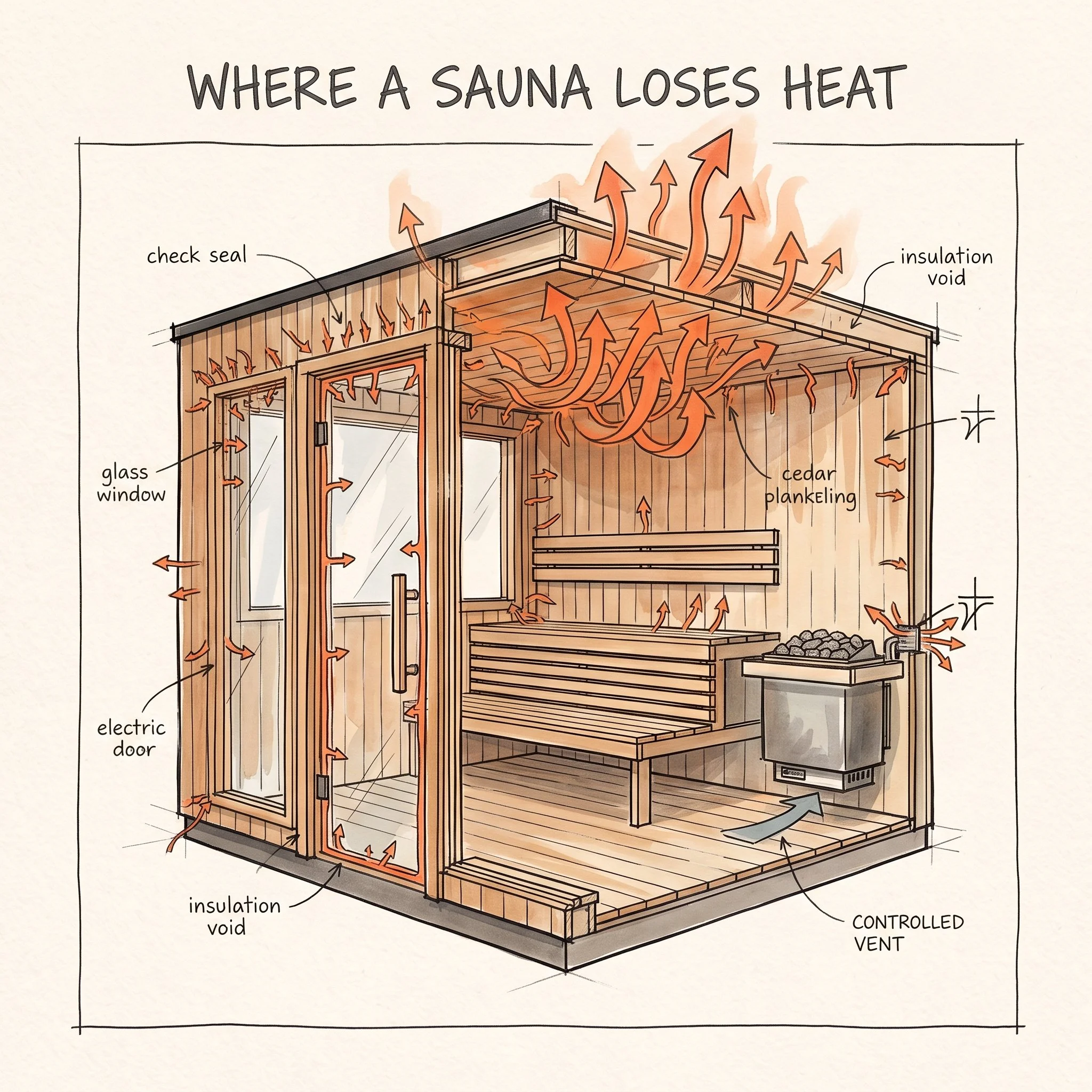
If we were inspecting a poorly performing sauna, the ceiling would be high on our list.
Heat rises.
That makes ceiling construction extremely important.
If the ceiling is poorly insulated or badly sealed, the hottest air in the sauna is accumulating directly against one of the weakest parts of the structure.
The heater keeps producing heat.
The heat rises.
The building keeps losing it.
The heater produces more.
That's not an efficient sauna.
Noble Saunas Treat the Ceiling as Part of the Complete Envelope
We don't think of sauna insulation as:
“Put some insulation in the walls.”
The ceiling is part of the same thermal enclosure.
Wall insulation, ceiling insulation, vapour barrier and sealing need to work together.
This becomes particularly important for our outdoor builds because the ceiling or roof assembly can be exposed directly to Alberta winter conditions.
We are not trying to overpower a bad building with a massive heater.
We are trying to build a better building.
5. There Is Too Much Glass for the Heater
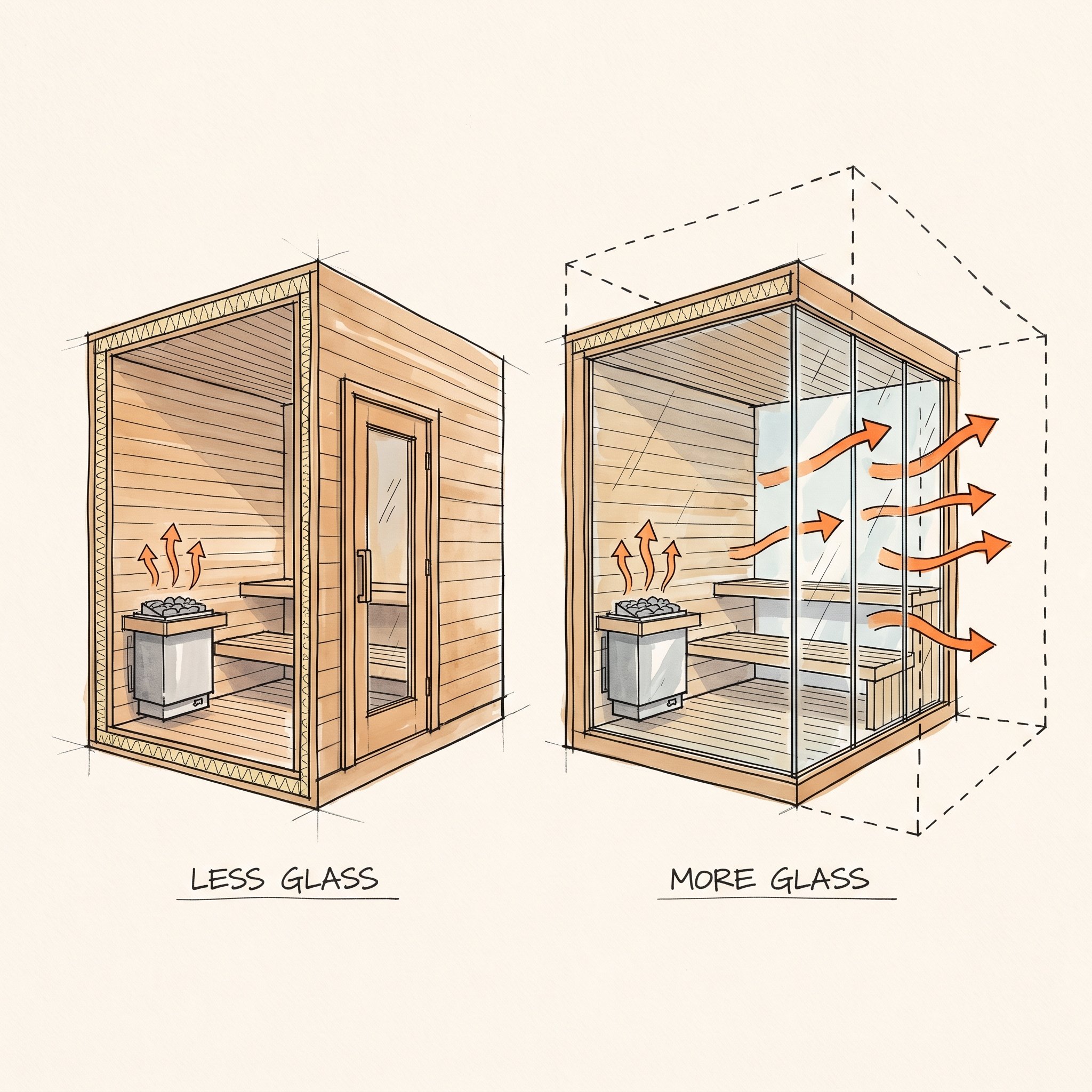
We love glass in saunas.
Our sauna designs regularly incorporate:
Full glass doors
Large windows
Tall side windows
Architectural glazing
Views into the surrounding landscape
Glass can completely transform the experience.
But glass also changes heater sizing.
An insulated wall and a sheet of glass do not retain heat the same way.
The larger the glass area becomes, the more important it is to consider that extra heat loss when selecting the heater.
This means a sauna with a physical volume of 400 cubic feet may have an effective heating demand greater than 400 cubic feet.
This Is Why Noble Designs the Entire Sauna Together
We don't treat:
windows
heater
walls
bench layout
as four unrelated choices.
They affect each other.
Want a dramatic wall-sized window?
Great.
Now we consider that when choosing the heater.
Want a larger interior?
Great.
Now we make sure the heater, electrical supply and ventilation still make sense.
That is what custom design should mean.
Not simply changing the stain colour on a factory box.
6. The Door Isn't Sealing Properly
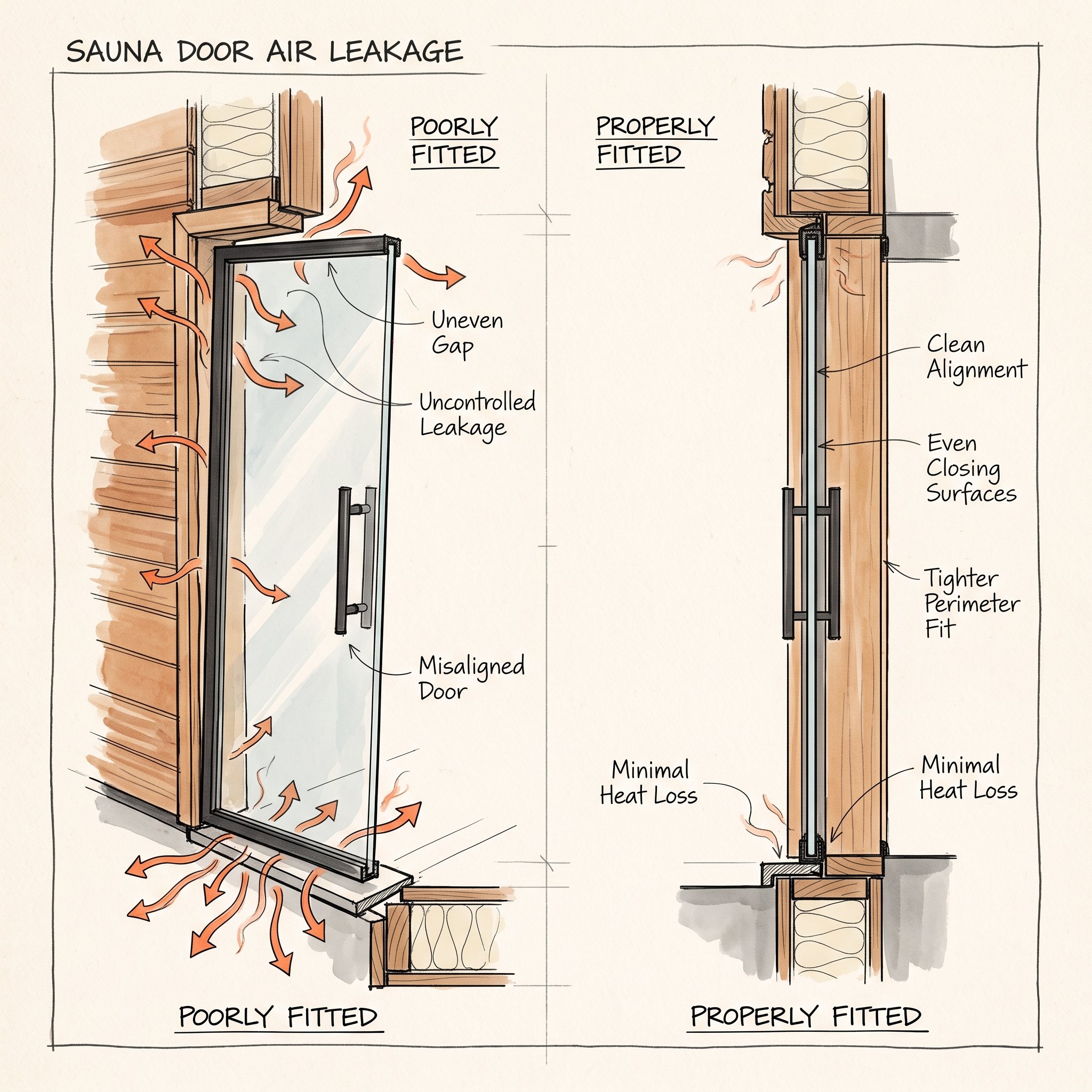
A sauna door is one of the biggest interruptions in the thermal envelope.
It has to:
Open safely
Close reliably
Handle constant heat cycles
Handle moisture
Work with ventilation
Survive seasonal movement
Minimize uncontrolled air leakage
And when the door contains a large sheet of glass, getting all of that right becomes even more challenging.
This is something we have spent considerable time refining on Noble Saunas.
We pay close attention to:
Door alignment
Closing action
Sealing surfaces
Thresholds
Hardware
Glass fitment
Air leakage
Because a beautiful glass door that constantly dumps heat isn't a great sauna door.
We want the architecture and the performance.
7. Your Heater Stones Are Packed Incorrectly
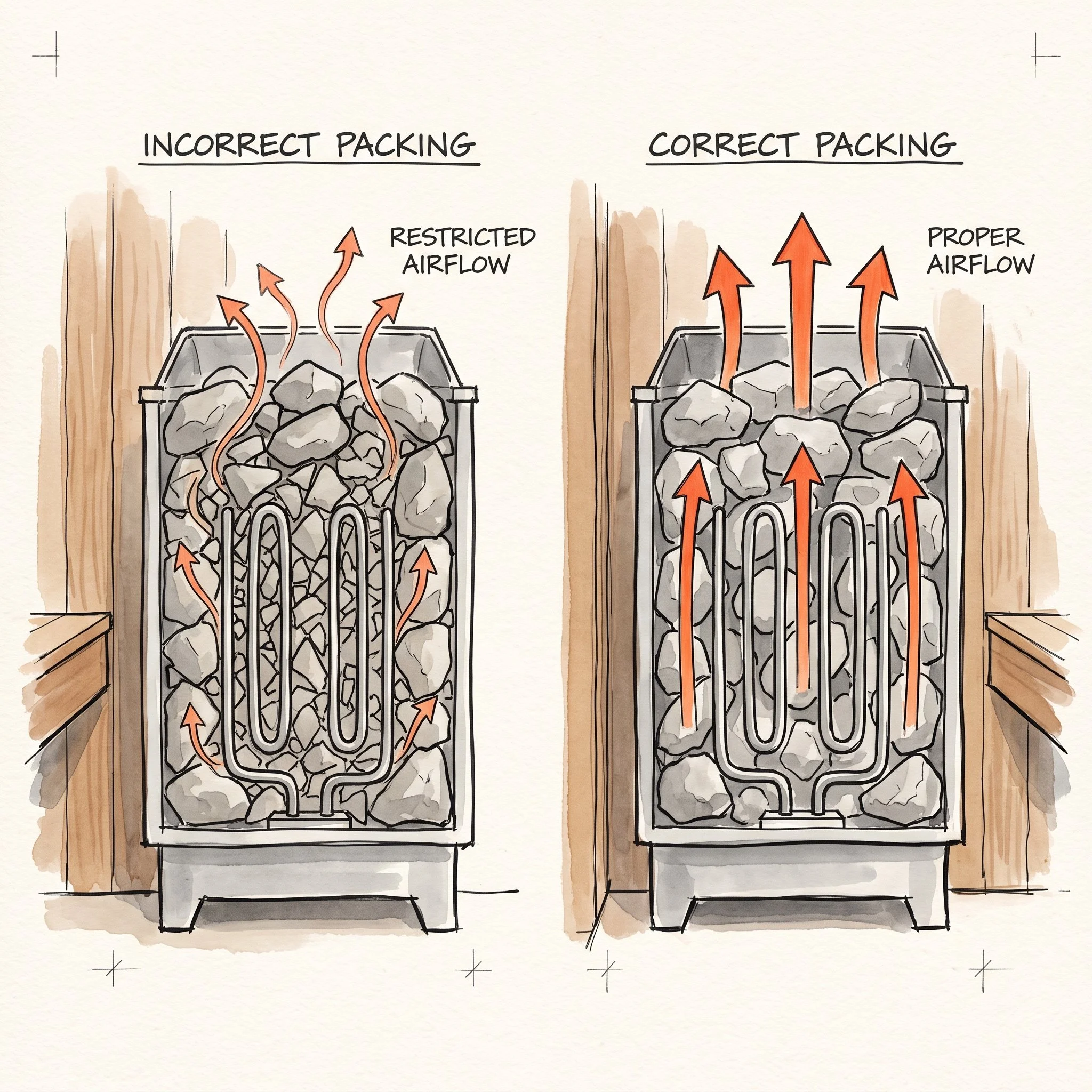
The stones aren't decoration.
They're part of the heating system.
Electric heating elements heat the stones, air moves through the heater, and the stone mass stores thermal energy.
When water hits properly heated sauna stones, that stored energy creates löyly—the steam and wave of heat that make a traditional sauna feel like a sauna.
Poorly packed stones can restrict airflow.
Old stones can crack and break down.
Small fragments can accumulate inside the heater.
If airflow becomes restricted, heater performance can suffer.
This is why a sauna heater needs ongoing care—not just installation.
At Noble Saunas, we don't simply select heaters based on the number printed on the box.
We also look at heater design and stone capacity because two heaters with the same kW rating can create very different experiences.
8. A Heating Element Isn't Working
Here's a problem that can be difficult to notice.
An electric heater might contain several heating elements.
If one stops working, the heater doesn't necessarily go completely cold.
The others may continue operating.
So from the outside it looks like:
The heater works.
Except it isn't producing its full rated output.
That can cause:
Long heat-up times
Poor winter performance
Difficulty reaching temperature
Slow recovery
Weak stone temperature
If you have an existing sauna that used to perform well and suddenly doesn't, electrical output should be part of the investigation.
Electrical diagnosis should be performed by a qualified electrician or appropriate sauna technician.
9. Your Temperature Sensor Is Causing the Heater to Shut Down Early
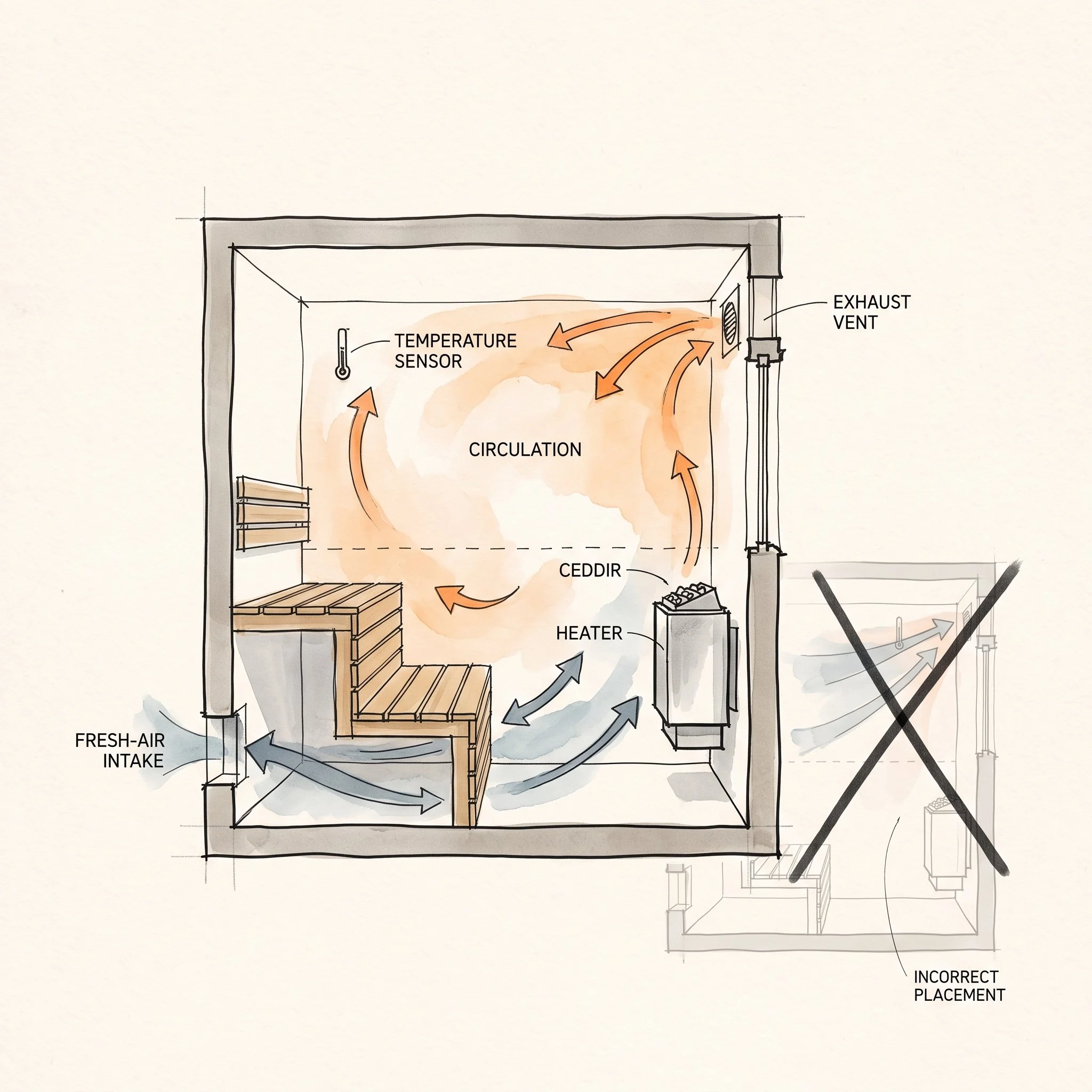
Modern sauna heaters commonly use a temperature sensor to tell the controller what's happening inside the room.
Sensor placement matters.
Imagine the sensor is sitting in a pocket of unusually hot air.
The sensor says:
“We're at temperature.”
The controller turns the heater off.
Except the rest of the sauna isn't actually ready.
This can produce a sauna where:
The upper wall is hot
The thermostat reading looks right
The heater keeps cycling
The bench area still doesn't feel hot enough
Moving the sensor randomly is not the answer.
Sensor location is specified by the heater manufacturer and is also part of the heater's safety system.
This is another reason we coordinate heater installation with the sauna design rather than treating it as an afterthought.
10. Ventilation Is Working Against the Heater
Ventilation is one of the most misunderstood parts of sauna design.
A sauna needs fresh air.
People sometimes react to poor heating by blocking every vent they can find.
That's usually the wrong approach.
The goal is not zero airflow.
The goal is controlled airflow.
Poorly designed ventilation can:
Remove hot air too aggressively
Deliver cold air in the wrong location
Interfere with the temperature sensor
Create uncomfortable temperature stratification
Reduce heater performance
Make the room feel stuffy despite being hot
At Noble Saunas, ventilation is considered alongside:
Heater position
Bench position
Door location
Room size
Interior layout
Again, it comes back to the same principle:
A sauna is a system.
11. Your Benches Are Too Low
This is a fascinating one because the sauna can technically be hot while the person inside still feels cold.
Hot air rises.
The upper portion of the sauna is naturally hotter than the floor.
If the benches are too low, bathers spend the entire session sitting below the best heat.
You can end up with:
A hot ceiling
A thermometer showing a high temperature
Cold feet
A mediocre sauna experience
Then someone concludes:
“We need a bigger heater.”
Maybe.
Or perhaps the room geometry is wrong.
Noble Saunas Are Designed From the Bench Out
Bench placement is not decorative.
It affects:
Comfort
Capacity
Heat exposure
Heater clearances
Circulation
Sauna experience
When we design a custom Noble Sauna, we think about where people will actually sit and lie down.
That same philosophy is explained in:
Our goal isn't to fit the maximum theoretical number of people into the smallest possible box.
It's to create a sauna that people actually want to use.
12. Your Sauna Is Simply Too Big
More sauna isn't automatically better sauna.
Every extra cubic foot needs to be heated.
Consider:
8 × 8 × 7 ft = 448 ft³
Now raise the ceiling two feet:
8 × 8 × 9 ft = 576 ft³
You have added 128 cubic feet of heated air.
Most of it is above your head.
The heater still has to deal with it.
This is why we don't make rooms larger just so the dimensions look impressive on a sales page.
The sauna should be sized according to how it will actually be used.
Efficient design creates better performance.
13. Your Sauna Works in Summer but Fails in Winter

This is an enormous warning sign with outdoor saunas.
If your sauna works reasonably well on a warm evening but becomes miserable when temperatures fall below freezing, the cold weather may simply be exposing weaknesses in the structure.
Cold weather increases the temperature difference between inside and outside.
That magnifies problems such as:
Poor insulation
Air leakage
Thin walls
Weak ceiling assemblies
Large glass areas
Poor door seals
Undersized heaters
This is exactly why Noble Saunas are built for Canadian conditions.
Calgary isn't Finland's mildest coastal town.
We can see warm summer temperatures followed by serious winter cold.
Outdoor structures need to be designed accordingly.
Our goal is not to build a sauna that works beautifully during the sales demonstration.
We want to build one you'll actually use in January.
Why Noble Saunas Are Different
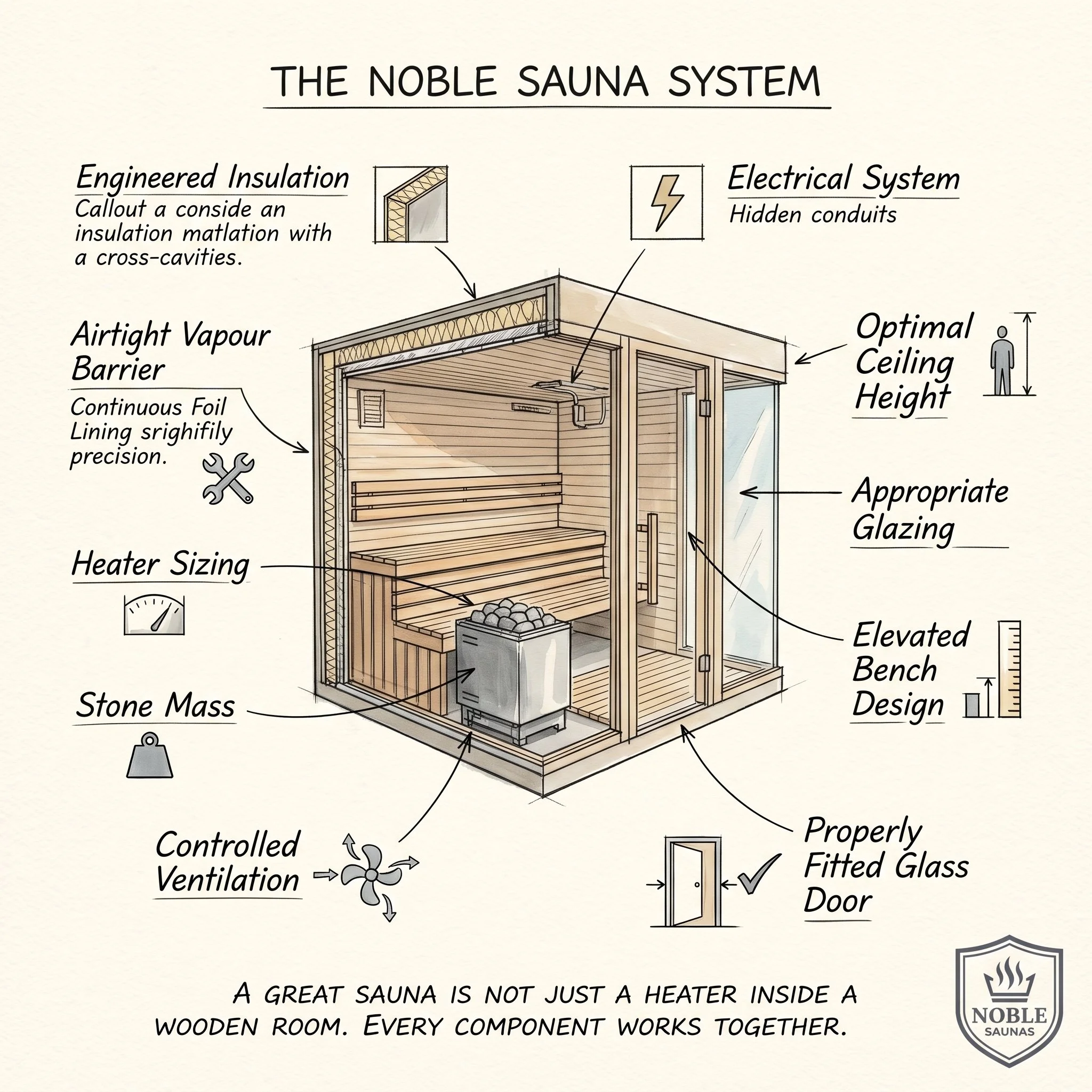
This is where all of these troubleshooting problems connect.
Many sauna companies primarily sell a product.
A box.
A barrel.
A kit.
A collection of panels.
At Noble Saunas, we approach the sauna as a construction project and a thermal environment.
We build.
That distinction matters.
Our Sauna Construction Includes Real Building Principles
Depending on the project and design, our approach includes things such as:
Framed wall assemblies
Insulation
Sauna-specific vapour-barrier systems
Carefully sealed joints
Air spaces behind interior finishes
Cedar interiors
Purpose-built benches
Proper exterior weather protection
Tempered sauna glazing
Ventilation planning
Heater sizing
Electrical coordination
Thoughtful door systems
Custom layouts
The result isn't a kit that happened to be assembled in your backyard.
It's a purpose-built sauna.
If you want a deeper explanation of that distinction, read:
Custom-Built Noble Sauna VS. Prefabricated Kits
We Build the Parts You Can't See
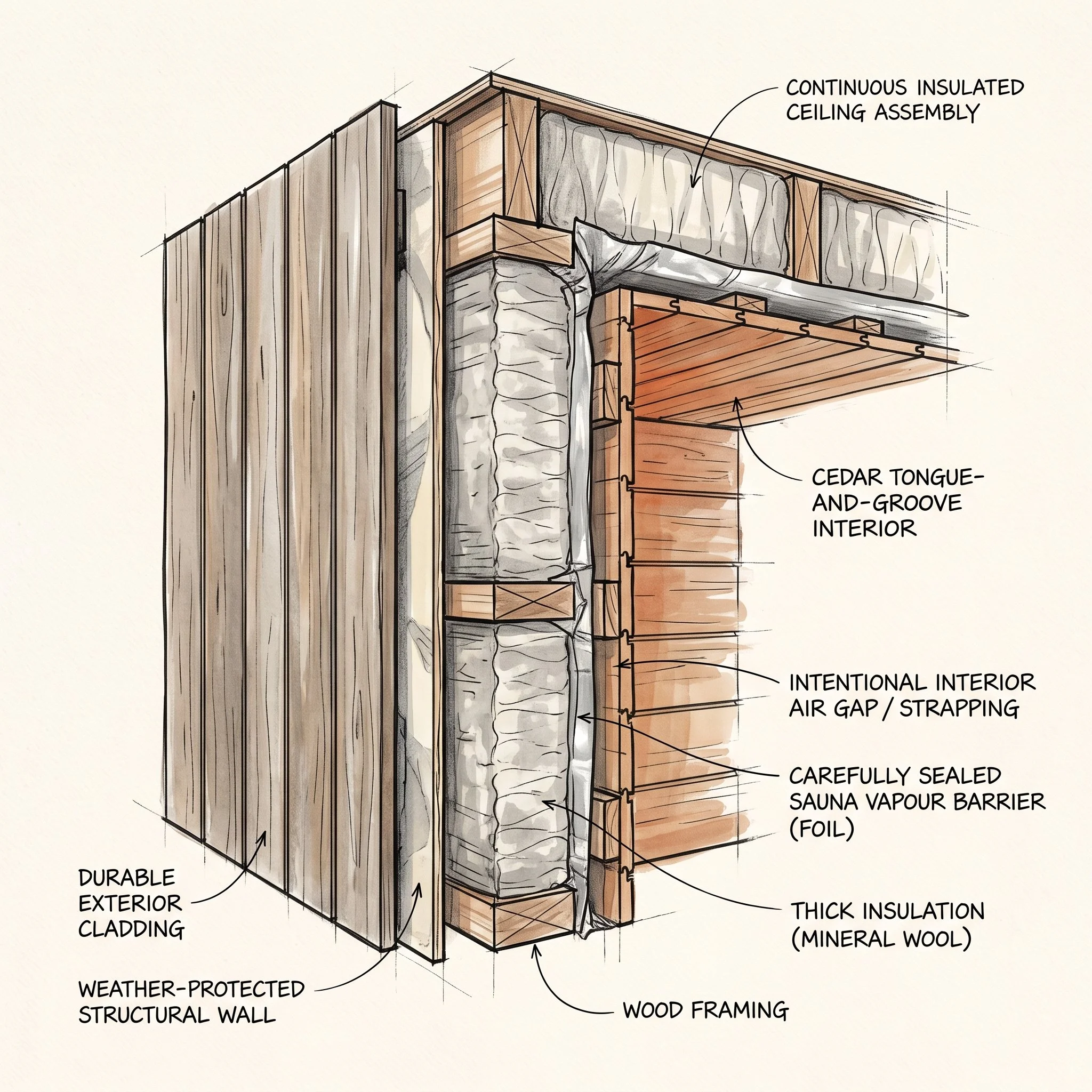
Some of the most important things in a Noble Sauna disappear before the client ever sees the finished product.
Insulation gets covered.
Vapour barrier gets covered.
Sealed penetrations get covered.
Framing gets covered.
Electrical gets integrated.
Air gaps disappear behind beautiful cedar.
And eventually you're standing inside a finished sauna thinking:
This feels solid. Quiet. Hot. Comfortable.
That's the point.
The finished cedar is beautiful.
But the things behind it are what allow the sauna to perform.
You can see more of that construction process in:
and:
Why Insulation Matters in a Sauna
We Don't Build Barrel Saunas
There are situations where barrel saunas make sense.
They're compact, recognizable and relatively easy to manufacture and ship.
They're simply not what we want to build.
Our focus is on insulated, high-performance sauna construction.
We want control over:
Thermal performance
Wall construction
Air sealing
Interior geometry
Bench position
Heater sizing
Exterior durability
Doors
Windows
Finishes
That is much easier to accomplish when you're designing a sauna as a real structure.
If maximum affordability and simplicity are your priorities, there are plenty of barrel and kit manufacturers available.
If you're looking for something built around performance, longevity, Canadian weather and craftsmanship, that's where Noble Saunas comes in.
Our Sauna Designs
Not every client wants the same sauna.
That's why we build both established Noble Sauna models and completely custom designs.
Our sauna work ranges from compact private hot rooms to larger architectural outdoor saunas.
One of the projects that helped define this direction was the Noble Somnium.
You can read about its development here:
That same design philosophy continues through our newer sauna models and custom builds:
Don't start with what is easiest to manufacture.
Start with the sauna experience we want to create.
Then figure out how to build it properly.
We Also Build Custom Interior Saunas
Noble Saunas isn't limited to backyard structures.
We also design and construct custom interior saunas.
That means we can take an existing interior space and build the hot room properly from the inside out:
Framing
Insulation
Vapour barrier
Electrical coordination
Ventilation
Cedar
Benches
Lighting
Glass
Heater integration
Interior saunas come with a different set of construction considerations because the sauna interfaces directly with the rest of the building.
Moisture control, ventilation and thermal separation become especially important.
It isn't simply:
“Put cedar on the walls and add a heater.”
We Can Also Diagnose Existing Saunas
Sometimes you already own the sauna.
And it doesn't work properly.
That's where this entire article becomes useful.
An existing sauna may be repairable.
Depending on the problem, troubleshooting might involve:
Checking heater sizing
Evaluating the hot-room volume
Inspecting ventilation
Checking heater operation
Reviewing sensor placement
Looking for heat loss
Inspecting door fit
Reviewing stone condition
Assessing insulation and construction
Sometimes the answer is a relatively straightforward repair.
Sometimes the existing sauna needs significant retrofitting.
And sometimes the underlying construction simply isn't capable of delivering the level of performance the owner wants without major changes.
We'd rather diagnose that properly than immediately sell someone a larger heater.
A Bigger Heater Isn't Always the Answer
This is one of the most important lessons in sauna construction.
When a sauna won't get hot, the simple response is:
“Put a bigger heater in.”
Sometimes that's correct.
But a larger heater does not repair:
Missing insulation
Bad air sealing
Poor door fit
Incorrect ventilation
Bad bench geometry
Failed electrical components
Incorrect sensors
Excessive uncontrolled heat loss
You can sometimes overpower bad construction with enough electricity.
We don't think that's good sauna design.
At Noble Saunas, our goal is to make the building efficient first, then match the heater to it.
That is a fundamentally different approach.
The Difference Between Getting Hot and Being a Great Sauna
Almost any enclosed room can be made hot if you put enough energy into it.
That isn't the standard we're aiming for.
A great sauna should:
Heat predictably
Hold temperature
Recover after the door opens
Produce excellent steam
Feel comfortable at bench level
Remain quiet
Control moisture
Perform in winter
Look beautiful
Feel substantial
Be something you actually want to use for years
That's what we're trying to build with every Noble Sauna.
There is a lot happening behind the cedar to make that possible.
Thinking About Building a Sauna?
If you're researching saunas because you're planning one of your own, these Noble Journal articles are a good next step:
What Size Of Sauna Do I Need?
Choose a practical sauna footprint based on real usage, bench space and efficiency.
Why Insulation Matters in a Sauna
See why insulation, vapour barrier and proper wall construction have such a large impact on performance.
Electric vs Wood-Fired Sauna Heaters
Compare the two major traditional sauna heating options.
Custom-Built Noble Sauna VS. Prefabricated Kits
Learn why we choose to build insulated custom saunas instead of selling thin-wall kits.
From Sketch To Sweat
See what happens between the initial sauna idea and the finished hot room.
Birth of the Noble Somnium
See how one of our signature Noble Sauna designs came together.
Why Choose Noble Services (and why not to)
A transparent look at how we approach workmanship, quality, pricing and the clients we're best suited to work with.
Build a Sauna That Performs From the Beginning
If you're still in the planning stage, this is the best time to get these decisions right.
Don't start with a heater.
Don't start with a “six-person” label.
Don't start with a kit size.
Start with:
How will you use the sauna?
Then design the room, benches, insulation, glass, ventilation and heating system around that answer.
That's how we approach our work at Noble Saunas.
We design and build custom, fully insulated saunas with a focus on performance, craftsmanship and longevity—whether we're building one of our established Noble models or creating something completely custom for your property.
If you're looking for a thin, inexpensive hot box, there are easier ways to buy one.
If you're looking for a sauna that is designed as a real building, insulated for Canadian conditions and built to perform, we'd be happy to talk.
Explore Noble Saunas
nobleservices.ca/saunas
Noble Services Canada Inc. — Calgary, Alberta
Serving clients across Canada and the United States.