

Sauna Ventilation: Where Should the Intake and Exhaust Vents Go?
Why Proper Airflow Matters Just as Much as Heat
A sauna needs heat.
But it also needs air.
That balance is where a lot of sauna designs go wrong.
People often assume that the best sauna is the one that traps every possible bit of heat inside. So they insulate it, seal it tightly, close every vent and try to make the room completely airtight.
That sounds efficient.
It isn't.
A properly built sauna should be well insulated and carefully air sealed, but it also needs intentional ventilation.
Those are two very different things.
At Noble Saunas, we want to control exactly where fresh air enters, how it moves through the hot room and where stale, humid air leaves.
We don't want random gaps in the building providing ventilation for us.
We want the sauna envelope sealed properly, and then we introduce airflow where it actually belongs.
That controlled airflow helps create:
Fresh air for bathers
More even temperatures
Better heat circulation
Better heater performance
Better humidity control
More comfortable bench temperatures
Better drying after the session
Less chance of stale, heavy-feeling air
Ventilation isn't something that should be added after the sauna is already built.
It is part of the sauna design from the beginning.
Why Does a Sauna Need Ventilation?
A sauna is a small enclosed room operating at a very high temperature.
People are breathing inside it.
Water is being poured over stones.
Humidity changes rapidly.
The heater is continuously moving and heating air.
Without properly designed ventilation, the room can become uncomfortable even if the thermometer says the temperature is perfect.
Poor ventilation can contribute to:
Stale-feeling air
Excess humidity
Uneven heat
Hot heads and cold feet
Poor air circulation around the heater
Temperature stratification
Slow drying after use
Unnecessary moisture remaining in the room
Heater and temperature-sensor problems
HUUM specifically notes that good sauna ventilation helps prevent temperature layering and the familiar “cold feet” effect, where the upper room is hot while the lower portion remains noticeably cooler.
That matters because a sauna should not simply be hot at the ceiling.
It should feel good where the people are actually sitting.
A Sauna Should Be Sealed — But Not Unventilated
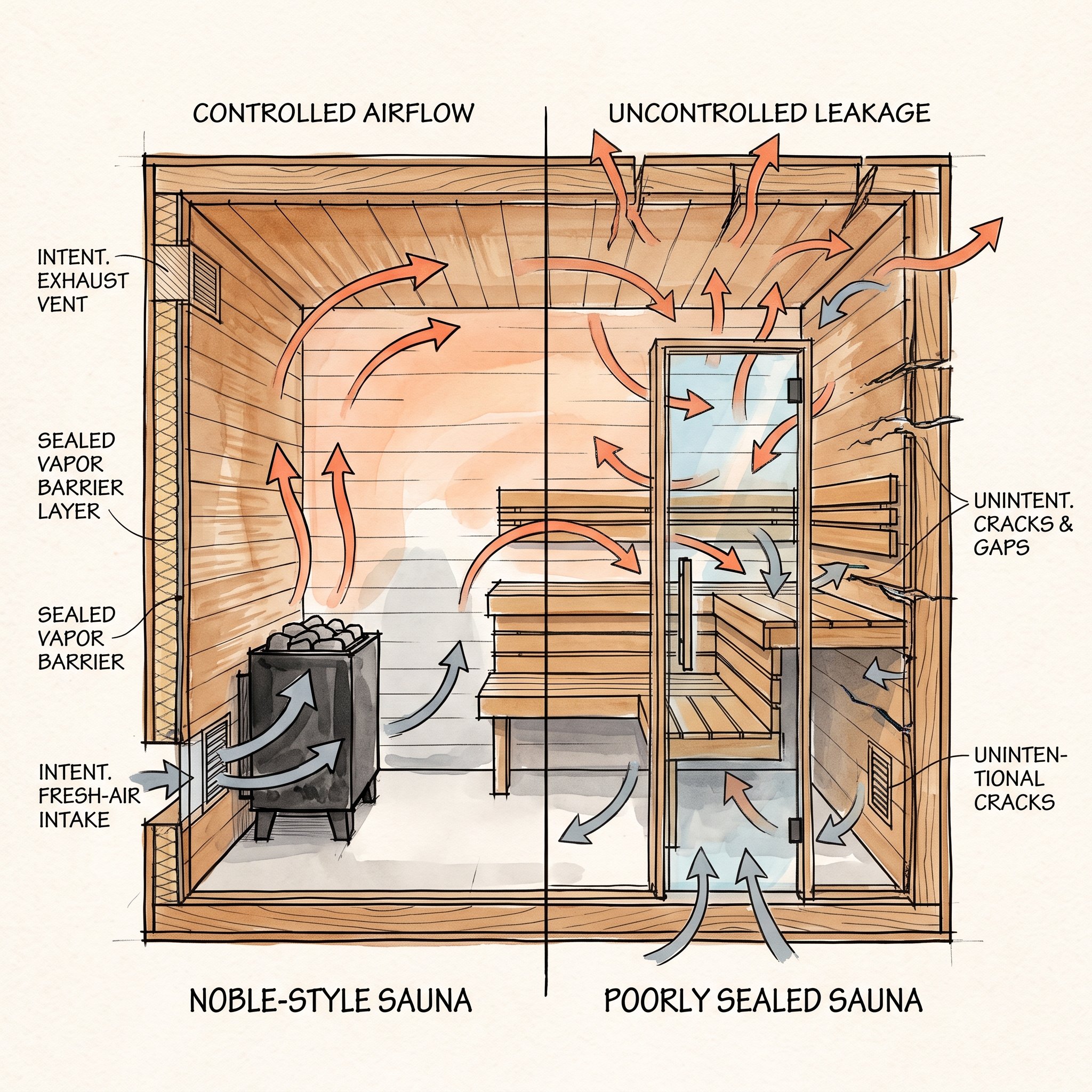
This distinction is worth understanding.
At Noble Saunas, we put substantial effort into the hot-room envelope.
We insulate.
We install and seal the sauna vapour barrier.
We pay attention to joints and penetrations.
We work on door fitment and uncontrolled air leakage.
You can read more about why that matters in:
Why Insulation Matters in a Sauna
and:
Why Your Sauna Isn’t Getting Hot Enough
But once we've built a controlled thermal envelope, the sauna still needs to breathe.
The goal is:
Seal the building. Design the airflow.
Not:
Leave random gaps and call that ventilation.
A purpose-built intake and exhaust system gives us far more control over the sauna experience.
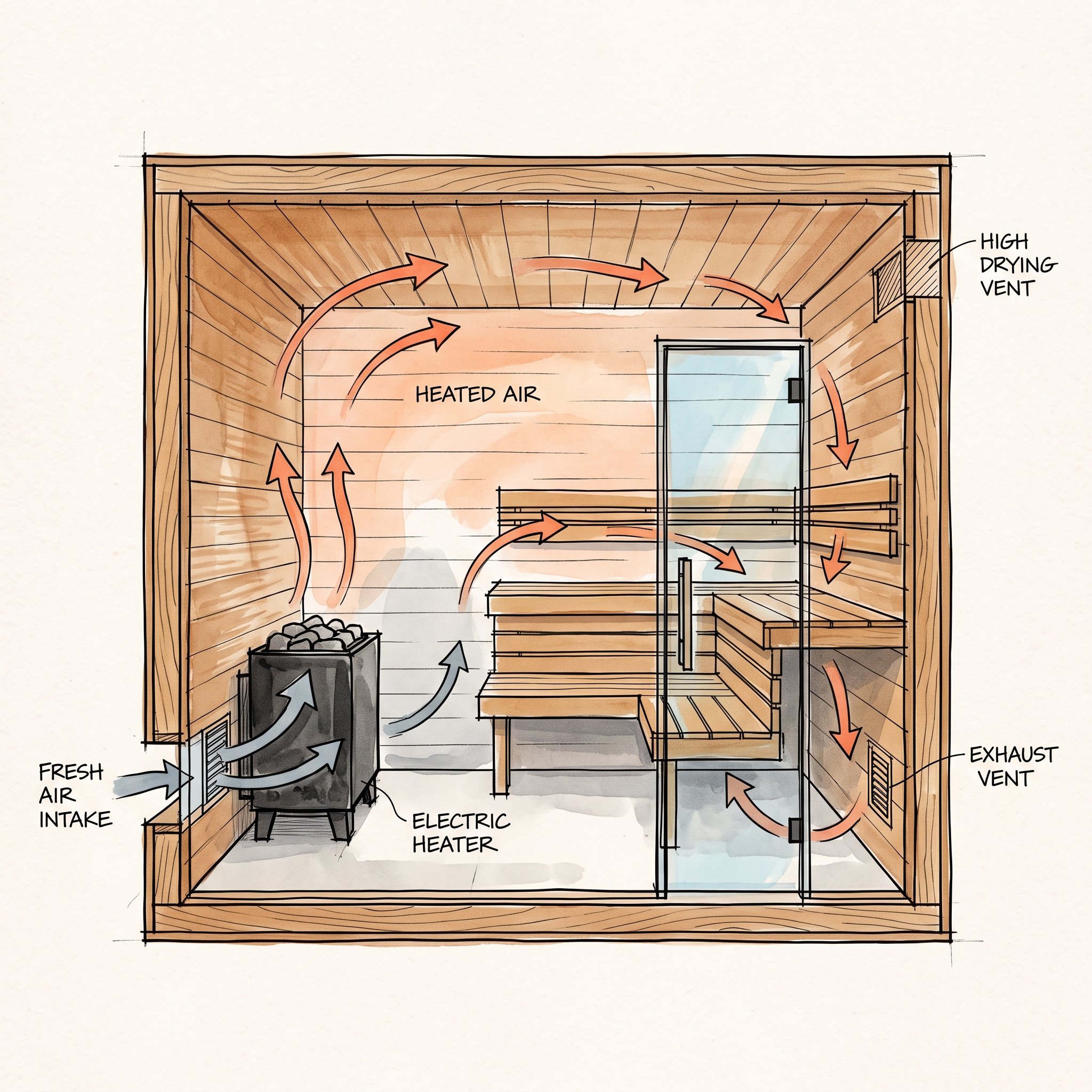
The Basic Sauna Ventilation System
A typical sauna ventilation system contains at least:
Fresh-air intake
Exhaust vent
And many designs also benefit from:
Drying vent
The intake brings fresh air into the sauna.
The exhaust removes stale and humid air.
The drying vent helps remove residual moisture after the sauna is finished.
Where those openings are located depends on:
Electric vs wood-burning heater
Natural vs mechanical ventilation
Heater design
Temperature-sensor position
Bench layout
Room dimensions
Whether the sauna is indoor or outdoor
This is why there isn't one universal drawing that works for every sauna.
How Much Air Should a Sauna Move?
Harvia and HUUM both provide guidance indicating that sauna air should exchange approximately six times per hour in a properly designed system.
That doesn't mean blasting cold air through the room.
It means providing enough controlled air movement that fresh air enters, mixes with the heated air and is eventually exhausted.
The key word is:
circulation.
If air simply enters one vent and immediately exits another without circulating through the room, the ventilation isn't accomplishing much.
Where Should the Fresh-Air Intake Go?
This is where heater type and ventilation method become important.
The general goal is to introduce fresh air near the heater so that incoming cooler air can be warmed and carried into the circulation pattern of the sauna.
You usually do not want cold incoming air dumping directly onto the bathers.
And you especially don't want it incorrectly cooling the heater's temperature sensor.
Electric Sauna + Gravity Ventilation
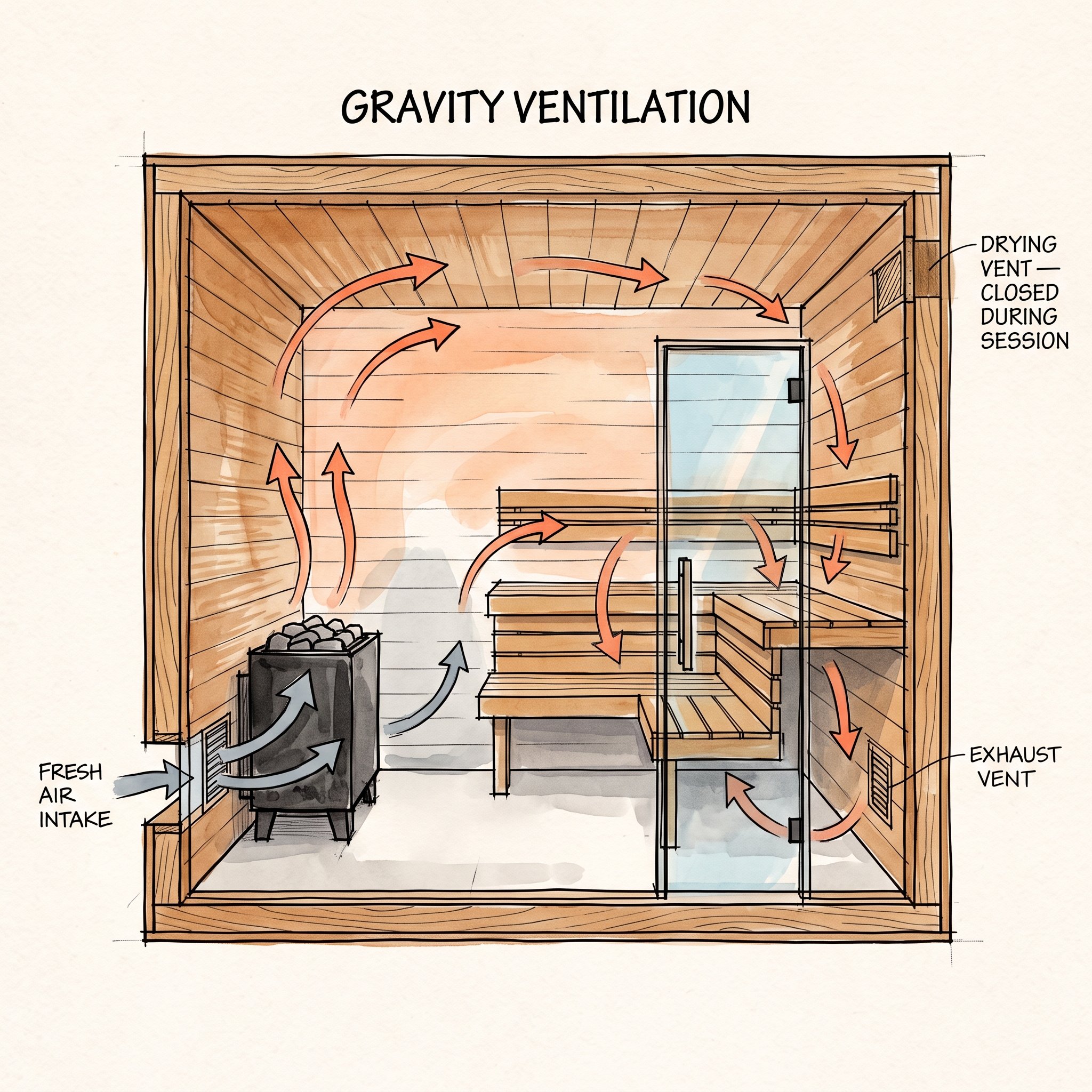
For a naturally ventilated electric sauna, manufacturer guidance commonly places the intake below or beside the heater.
Harvia recommends placing the gravity-ventilation supply air below or next to the electric heater.
HUUM's guidance for several electric heaters similarly places the gravity-based fresh-air intake around the middle of the heater or lower.
The idea is simple:
Cool fresh air enters near the heater.
The heater warms that air.
The warmed air rises.
That movement helps establish circulation through the room.
Electric Sauna + Mechanical Ventilation
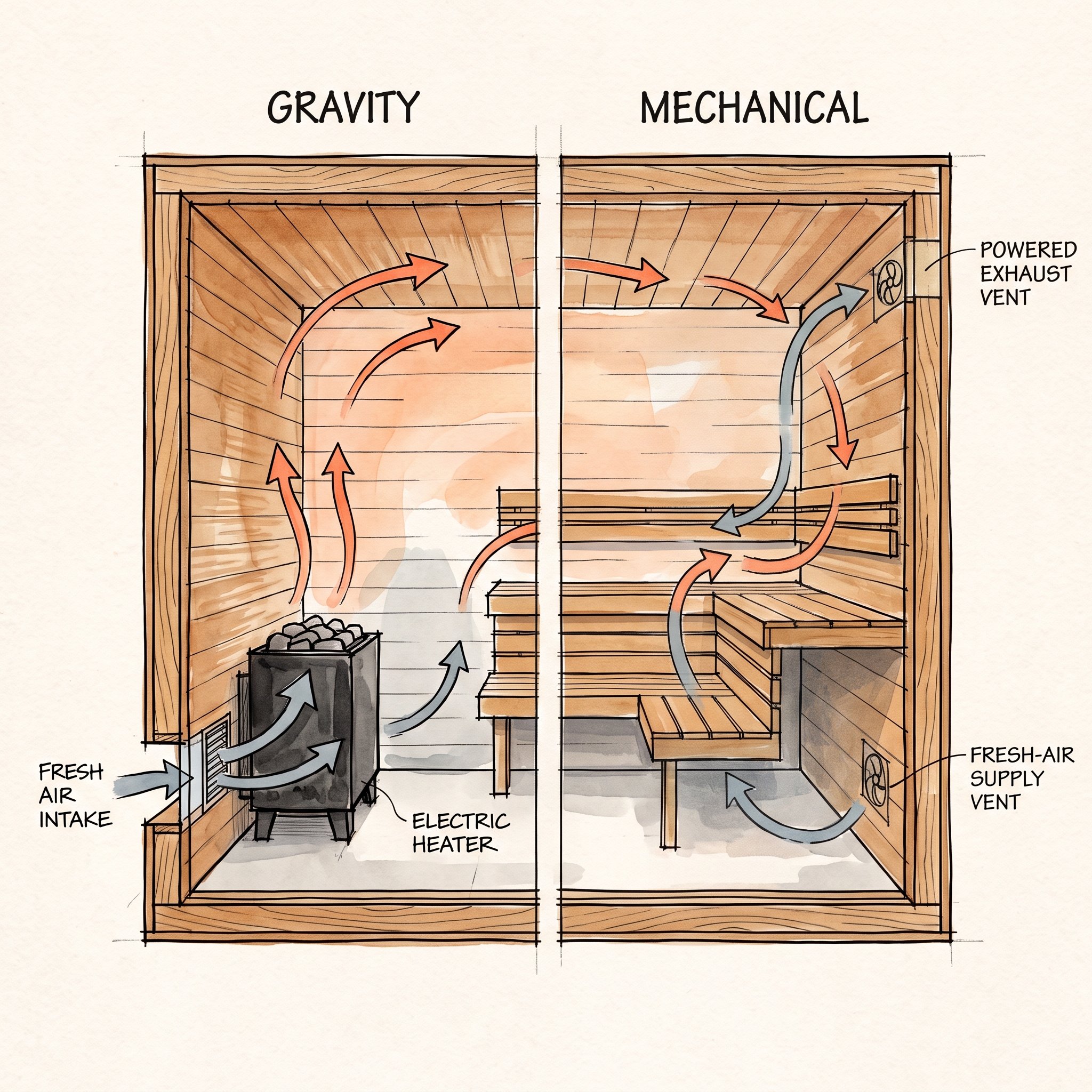
Mechanical ventilation changes the airflow pattern.
When a powered exhaust or building ventilation system is moving air, manufacturer guidance may place the fresh-air intake higher around or above the heater.
For example, Harvia recommends placing mechanically supplied fresh air in the upper portion of the sauna while making sure that airflow does not interfere with the heater's temperature sensor.
HUUM similarly specifies higher supply-air placement for several mechanically ventilated electric-heater installations.
This is why copying the vent location from somebody else's sauna can be a mistake.
Their ventilation system may operate completely differently from yours.
Where Should the Exhaust Vent Go?
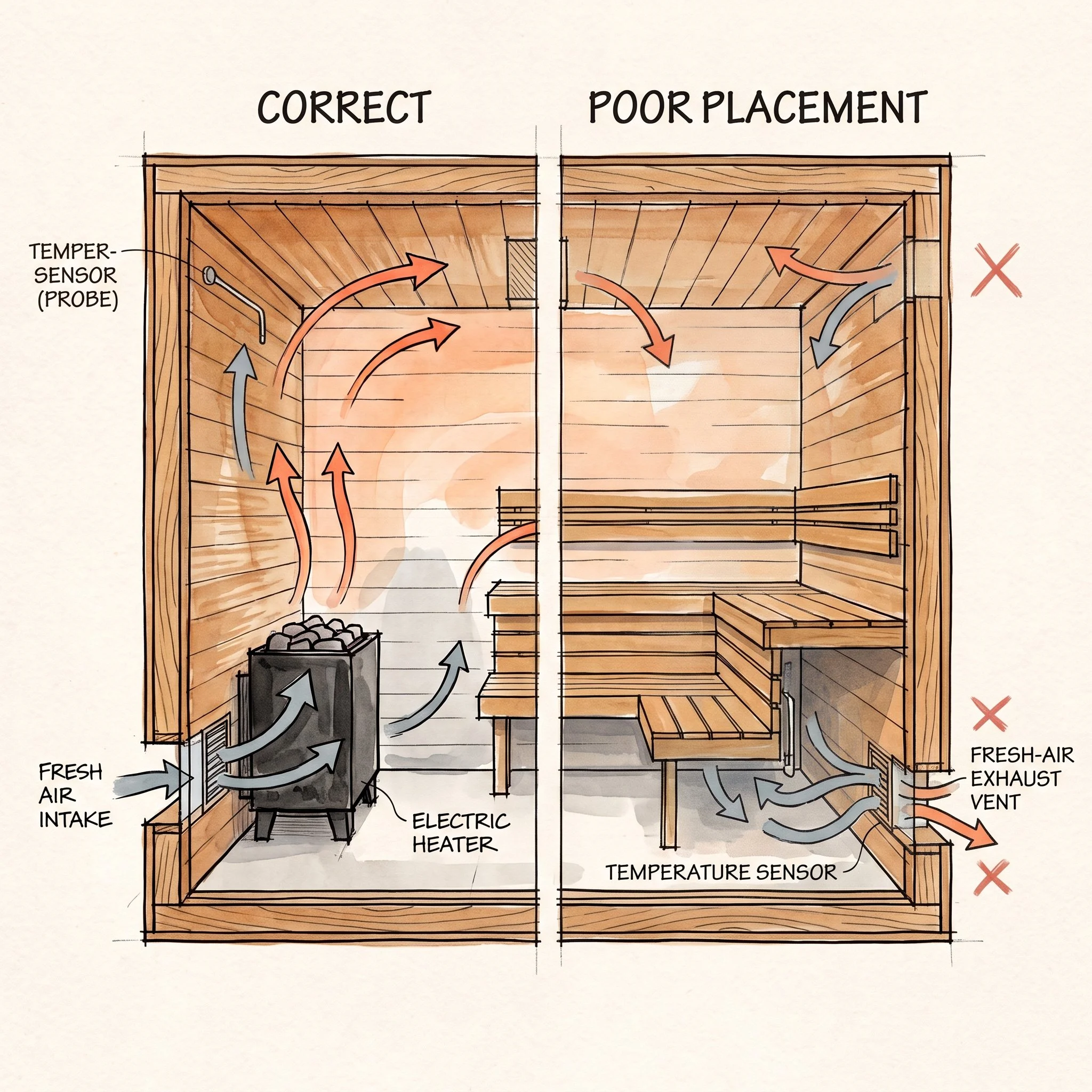
For many electrically heated saunas, the exhaust is located:
Low and away from the heater.
That positioning encourages air to move:
into the sauna near the heater → through the room → across the bathers → toward the opposite lower exhaust.
Harvia's guidance for electric saunas with gravity ventilation recommends placing the exhaust near the floor and as far away from the heater as practical.
HUUM also commonly places electric-sauna exhaust on the opposite side of the heater and relatively low in the room.
This can help bring warm fresh air through the occupied zone instead of letting all of the hottest air simply sit at the ceiling.
Why Put the Exhaust Low?
At first this sounds backwards.
Hot air rises.
So why wouldn't you simply put the exhaust at the ceiling?
Because during the sauna session, you generally don't want to immediately dump the hottest air out of the room.
You want circulation.
A lower exhaust can help draw air down through the room after it has mixed and passed through the occupied area.
A high outlet can be very useful for drying later, but if it acts as the primary open exhaust during the session, it may simply allow your hottest air to escape.
That's a poor trade.
What Is a Sauna Drying Vent?
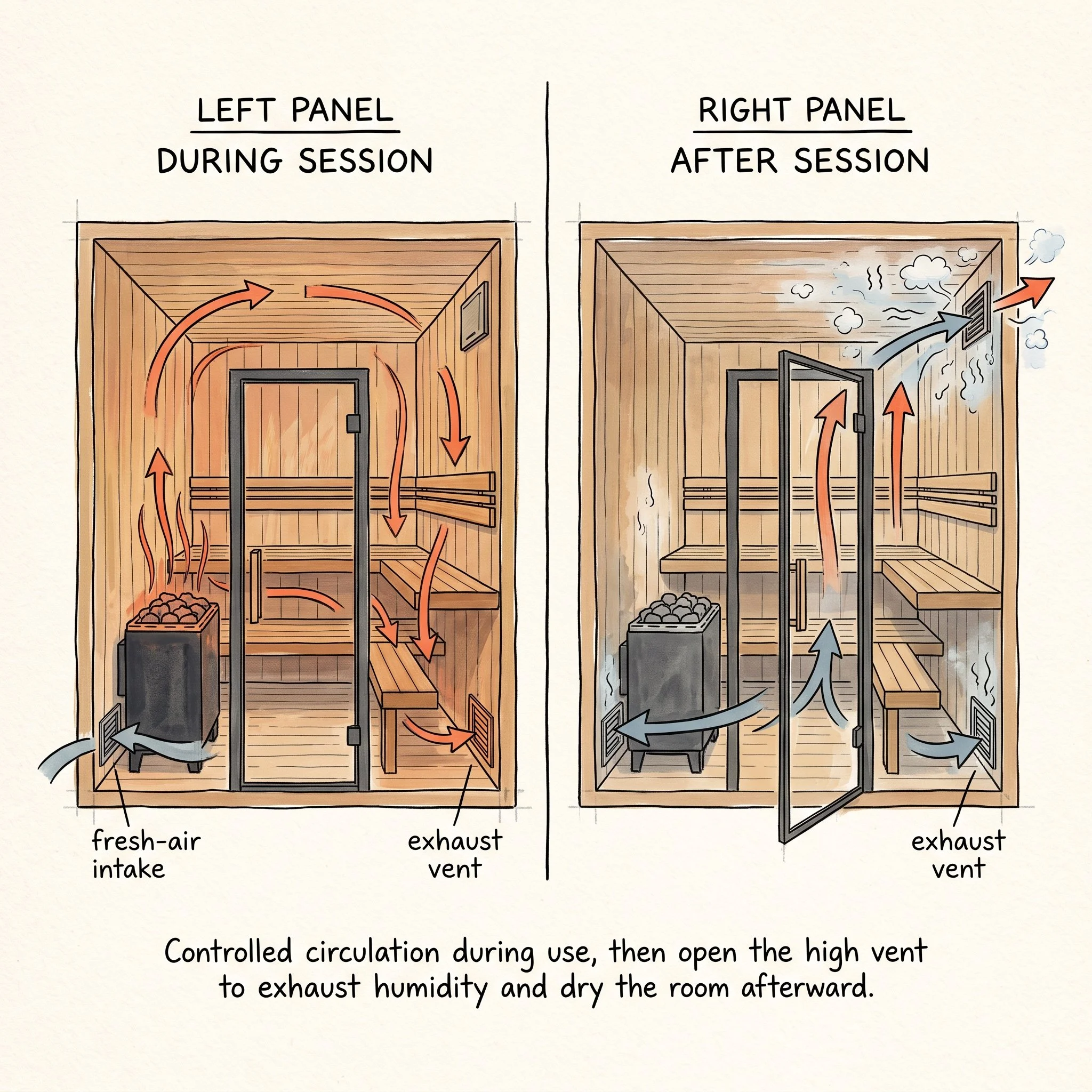
A drying vent is usually located higher in the room.
Its job is different from the primary operating exhaust.
During the actual sauna session, it may remain closed.
After you're finished, it can be opened to help warm, humid air escape and allow the room to dry.
HUUM and Harvia both describe high drying ventilation as part of sauna ventilation strategies, depending on the system.
This is particularly useful in a properly insulated Noble Sauna because we don't want moisture sitting inside the hot room indefinitely after use.
We want to:
heat it, enjoy it, ventilate it, dry it.
Ventilation Is Also Moisture Management
A sauna isn't only hot.
It's humid.
Every time you throw water over the stones, you temporarily increase the amount of moisture in the air.
Then people leave.
The heater turns off.
The room cools.
If that moisture remains trapped, it can settle onto cooler surfaces.
Good post-sauna ventilation helps the room dry.
That is one of the reasons Noble Saunas are designed as complete assemblies rather than simply cedar interiors.
Moisture control also depends on:
Proper vapour barrier
Sealed wall assembly
Interior air gap
Suitable materials
Ventilation
Drying
Those systems all work together.
You can see more of what goes behind the finished cedar in:
What About the Gap Under the Sauna Door?
Sometimes the space under a sauna door forms part of the ventilation strategy.
That doesn't automatically mean every sauna should have a giant uncontrolled gap underneath the door.
Whether that opening is appropriate depends on the complete ventilation design.
For some indoor saunas, air may be exhausted into an adjacent washroom or mechanical ventilation system, and manufacturer guidance can specify a substantial opening beneath the door to allow air transfer.
For an outdoor Noble Sauna, we generally want to think differently.
We don't want to create unnecessary uncontrolled leakage directly to the outdoors simply because somebody once said:
“Sauna doors are supposed to have a big gap.”
We want to know exactly what that gap is doing.
If it is part of the designed ventilation path, fine.
If it's simply a badly fitted door losing heat, that's not the same thing.
Ventilation and Temperature Sensors
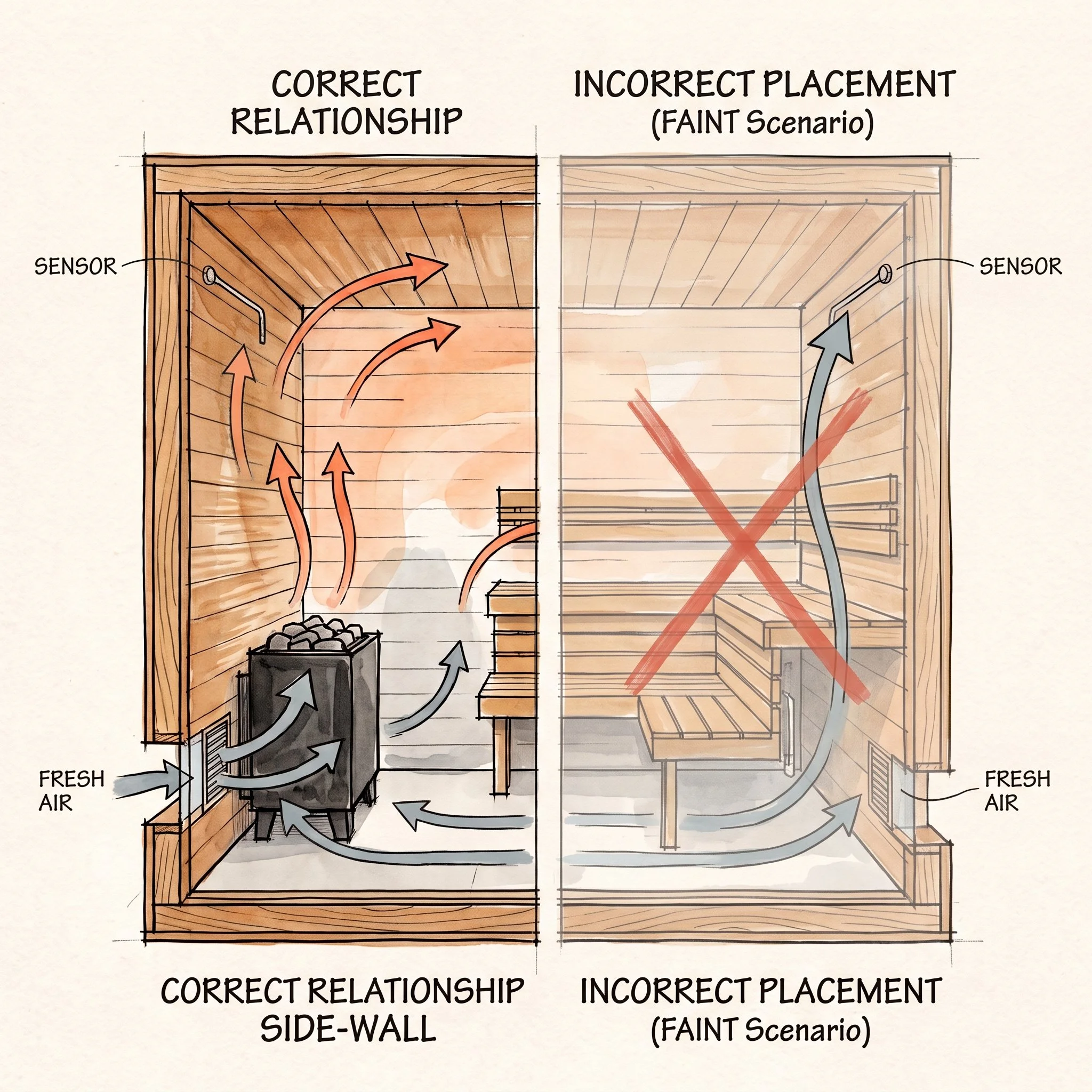
This is an extremely important detail with electric sauna heaters.
The heater's temperature sensor tells the control system how hot the room is.
Now imagine you place the fresh-air intake directly beside that sensor.
Cold air blows over it.
The sensor believes the sauna is cooler than it actually is.
The heater can behave incorrectly.
Or the opposite can happen.
If sensor placement doesn't represent the room properly, the heater may cycle off too early.
Harvia specifically warns against positioning supply airflow so that it cools the heater's temperature sensor.
HUUM likewise advises against locating temperature sensors too close to vents.
This is a perfect example of why Noble Sauna design considers:
heater + ventilation + sensor + room layout
at the same time.
Those decisions cannot be isolated from one another.
Ventilation and Bench Height
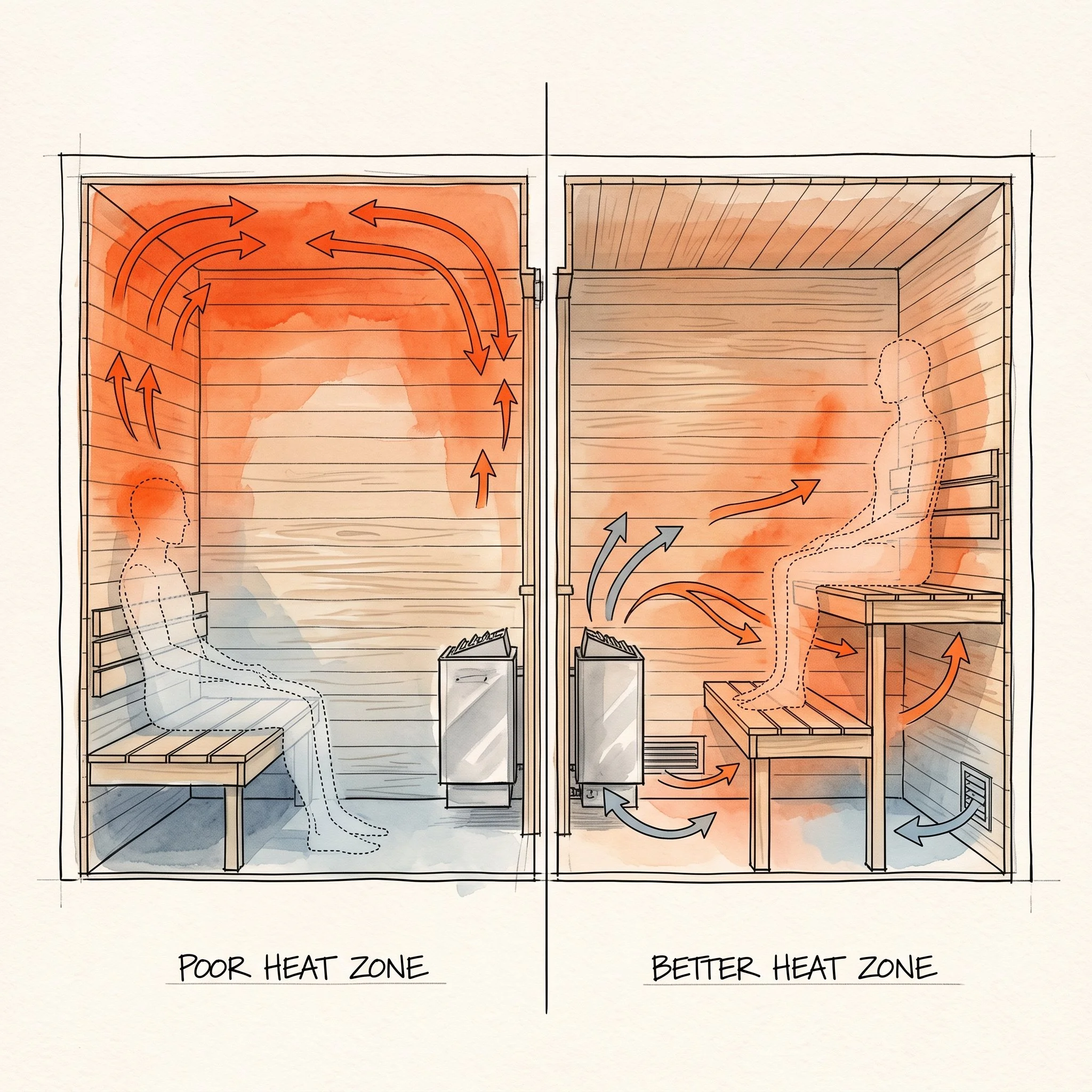
Ventilation also interacts with where you sit.
Hot air naturally stratifies.
The upper part of the room becomes hotter.
The lower part remains cooler.
If the benches are too low and the ventilation isn't moving air effectively, the bathers can end up sitting in a cooler layer while the ceiling is extremely hot.
That produces one of the worst sauna experiences:
hot head, cold feet.
We want the upper bench positioned within the useful heat zone while still maintaining suitable ceiling clearance and heater safety requirements.
The room's airflow should then help reduce extreme temperature stratification.
This is another reason we design around actual bench usage rather than vague advertised capacity.
For more on how we size the room itself:
Ventilation Does Not Fix an Undersized Heater
Ventilation matters.
But so does heater capacity.
If your sauna has a heater that is dramatically too small for the room, changing vent placement isn't going to magically solve the problem.
Similarly, if you have an enormous amount of glass or an uninsulated room, you may be dealing with a heating-load problem rather than an airflow problem.
That is why we look at the whole system.
If you haven't already, read:
How Many kW Does a Sauna Heater Need?
and use our:
Noble Sauna Heater Calculator
to get a preliminary heater-size estimate from your interior hot-room dimensions.
Heater sizing and ventilation are connected.
Neither should be guessed.
Can a Sauna Have Too Much Ventilation?
Absolutely.
More airflow is not automatically better.
If you leave oversized vents wide open and continually pull large amounts of cold outdoor air through an outdoor sauna, you're making the heater replace that lost heat continuously.
HUUM's heater troubleshooting guidance specifically recommends checking whether excessive ventilation is contributing to heating problems.
The goal is not maximum airflow.
It's appropriate airflow.
Enough fresh air to keep the sauna comfortable and circulating properly.
Not so much that you're constantly throwing heated air outside.
Common Sauna Ventilation Mistakes
Here are some problems we would watch for in an existing sauna:
Intake and exhaust too close together
Fresh air enters.
Then immediately leaves.
Very little of the room benefits.
Intake blowing directly on bathers
Instead of comfortable circulation, you get an unpleasant cold draft.
Intake affecting the temperature sensor
The heater receives a misleading temperature reading.
Exhaust too high during normal operation
Your hottest air may be leaving the sauna before it has done anything useful.
No useful drying ventilation
The sauna remains humid for too long after use.
Too much ventilation
The heater spends unnecessary energy continuously replacing lost heat.
Too little ventilation
The room can feel stale, heavy and stratified.
Vents added after the entire sauna was designed
Now you're trying to make airflow work around bench layouts, heaters and sensors that were never planned for it.
At Noble Saunas, we want these decisions made before the cedar goes up.
What About Wood-Burning Sauna Ventilation?
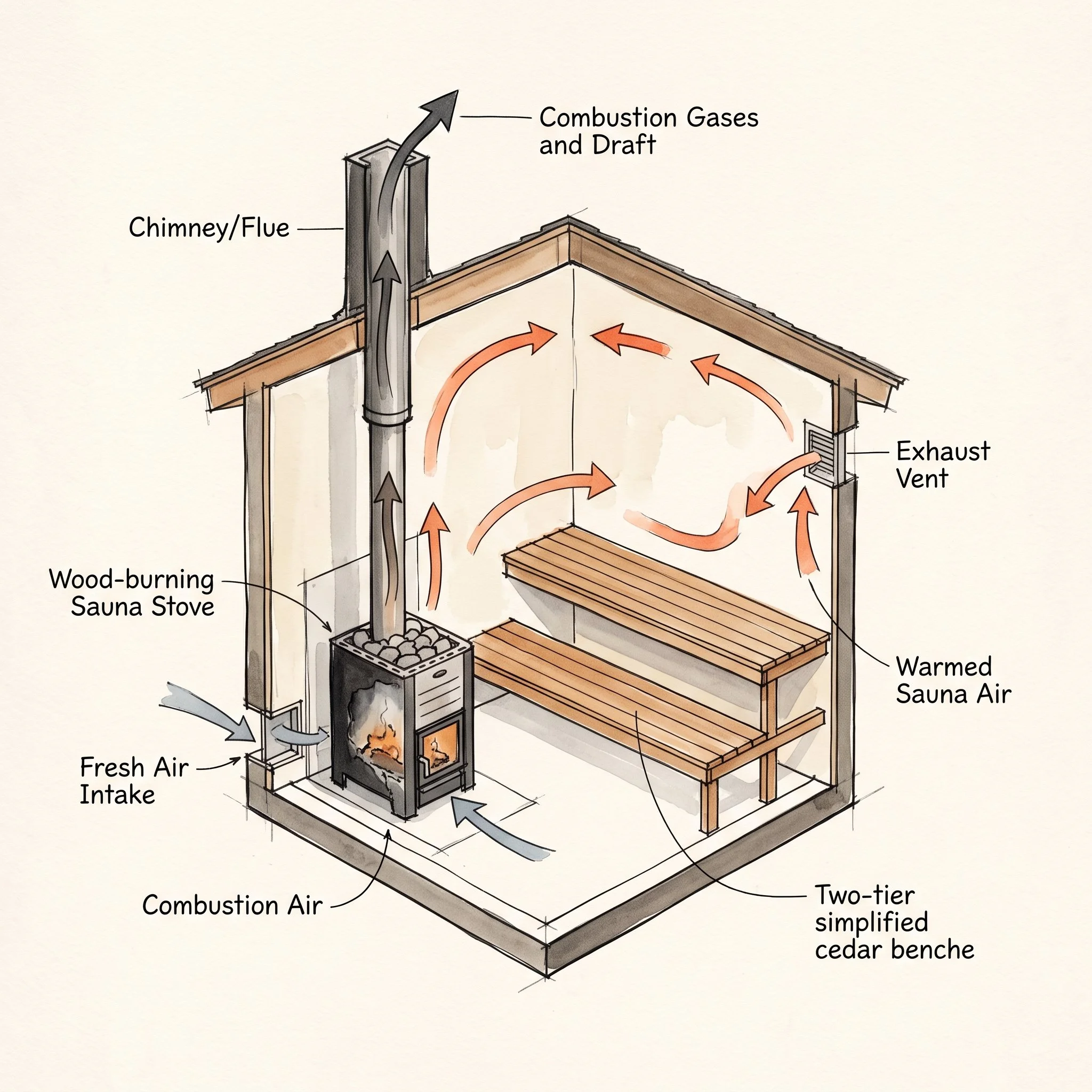
Wood-burning sauna stoves change the ventilation conversation because the fire itself requires combustion air.
Depending on the design, the stove may also contribute significantly to air movement and exhaust.
Harvia's guidance for naturally ventilated wood-burning saunas places fresh air low near the stove, with an outlet farther away.
Mechanical ventilation around a wood stove requires even more careful planning because pressure differences can affect combustion and potentially create unsafe conditions.
HUUM warns that poorly designed forced ventilation around a wood-fired stove can create incorrect pressure relationships and potentially contribute to combustion gases moving in the wrong direction.
That is not an area for guesswork.
If you're trying to decide whether electric or wood-fired heating is right for your project, read:
Electric vs Wood-Fired Sauna Heaters
At Noble Saunas, wood-burning systems are treated as complete stove, chimney, clearance, combustion-air and ventilation installations—not simply a firebox sitting inside a wooden building.
Natural Ventilation vs Mechanical Ventilation
There are two broad ways to move air through a sauna.
Natural / Gravity Ventilation
This relies on:
Temperature differences
Pressure differences
Natural convection
It is simple and can work very well in the right sauna.
This is often practical for standalone outdoor saunas where we can design vent positions directly into the structure.
Mechanical Ventilation
This uses powered ventilation to intentionally move air.
It can offer greater control, especially in interior saunas or buildings that already use mechanical ventilation systems.
But it also means you need to understand:
Airflow direction
Pressure
Fan capacity
Intake position
Exhaust position
Sensor interaction
One isn't automatically better than the other.
The right system depends on the sauna.
Indoor and Outdoor Saunas Are Different
An interior sauna built inside a home may interact with the building's HVAC and exhaust systems.
An outdoor sauna is its own small structure.
That changes the design problem.
At Noble Saunas, we build both custom outdoor saunas and custom interior saunas, but we don't assume the same ventilation solution belongs in both.
An interior sauna may require coordination with:
Existing mechanical ventilation
Adjacent bathrooms
Building-envelope requirements
Moisture control
Existing ducts
Exhaust systems
An outdoor sauna gives us different freedoms, but it is also directly exposed to Canadian weather.
That's why every sauna needs a ventilation plan appropriate to the actual building.
How Noble Saunas Approaches Ventilation

This is where our construction background matters.
We don't begin with:
“Where should we drill two vent holes?”
We begin with the entire sauna.
We look at:
Interior volume
Heater type
Heater position
Temperature sensor
Bench heights
Bench locations
Door location
Glass
Insulation
Natural vs mechanical airflow
Intake position
Exhaust position
Drying
Outdoor conditions
Then we make those pieces work together.
That is the same philosophy behind the rest of our sauna construction.
You can read more about that approach here:
Custom-Built Noble Sauna VS. Prefabricated Kits
We are not trying to assemble a collection of unrelated sauna products.
We are trying to build one complete sauna system.
The Things You Don't See Matter
When a Noble Sauna is finished, you see:
Beautiful cedar.
Glass.
Benches.
Lighting.
The heater.
Maybe an incredible view outside.
What you don't see is often just as important.
Behind the finished surfaces are things like:
Framing
Insulation
Vapour barrier
Sealed joints
Air gaps
Electrical routing
Vent pathways
Structural details
That's where much of the performance comes from.
A sauna that looks beautiful but has poor airflow can still feel disappointing.
A sauna that looks beautiful but loses heat through every joint can still struggle.
A sauna that has an enormous heater but badly designed ventilation can still feel wrong.
At Noble Saunas, the finished appearance matters.
But performance comes first.
Why We Don't Simply Build Hot Boxes
You can make a small wooden room hot.
That is not difficult.
You can buy a heater, put it inside a box and eventually reach a high temperature.
But a great sauna should do more than display a high number on a thermometer.
It should feel:
Fresh
Even
Comfortable
Quiet
Powerful
Relaxing
The heat should surround you.
Steam should move naturally through the room.
Your feet shouldn't feel like they're sitting in a completely different climate from your head.
The room shouldn't feel stale.
And the heater shouldn't be fighting the building every minute it's operating.
That takes design.
Good Ventilation Makes Good Löyly Better
The traditional sauna experience isn't simply dry heat.
Water hits hot stones.
Steam rises.
Humidity changes.
The heat feels temporarily more intense.
That wave of steam and heat is löyly.
Air movement affects how that löyly travels through the room.
Good circulation can help the steam move through the occupied area instead of simply collecting in an awkward layer near the ceiling.
This is one reason we look beyond just maximum temperature.
A well-performing sauna is about:
heat + stones + steam + air movement + room geometry.
All of those parts affect the experience.
Planning a Sauna? Don't Leave Ventilation Until the End
If you're designing a sauna now, this is the time to think about airflow.
Before framing is complete.
Before cedar.
Before the heater is mounted.
Before the benches are permanently installed.
Know:
What heater you're using
Where it will go
Where the sensor needs to go
Where people will sit
Whether ventilation is natural or mechanical
Where fresh air will enter
Where exhaust air will leave
How the room will dry afterward
That is far easier than finishing the sauna and then trying to figure out why the air feels wrong.
Thinking About a Noble Sauna?
At Noble Saunas, we design and build fully insulated custom saunas in Calgary for clients across Canada and the United States.
Our sauna work includes:
Outdoor saunas
Interior saunas
Custom hot rooms
Established Noble Sauna models
Electric heating systems
Wood-burning systems where appropriate
Insulated wall and ceiling assemblies
Airtight vapour-barrier construction
Cedar interiors
Custom benches
Glass
Lighting
Ventilation planning
Heater integration
We don't want to build you a sauna that simply looks good when the photographs are taken.
We want it to perform every time you turn it on.
Keep Learning About Sauna Design
If you're planning a sauna, these Noble Journal articles go hand-in-hand with ventilation:
Why Your Sauna Isn’t Getting Hot Enough
Troubleshoot heater sizing, insulation, airflow, glass, stones and other common performance problems.
How Many kW Does a Sauna Heater Need?
Understand how interior volume and construction affect heater requirements.
Why Insulation Matters in a Sauna
See why the thermal envelope matters so much in an outdoor Canadian sauna.
What Size Of Sauna Do I Need?
Plan the hot room around real bench space and actual use.
Electric vs Wood-Fired Sauna Heaters
Compare electric and wood-burning heating systems.
From Sketch To Sweat
See what goes into building a Noble Sauna before the cedar hides all the important details.
Custom-Built Noble Sauna VS. Prefabricated Kits
Understand why we choose insulated custom construction over thin-wall sauna kits.
Build the Airflow Into the Sauna
Sauna ventilation should not be an afterthought.
Neither should insulation.
Neither should heater sizing.
Neither should the benches.
They are all part of the same room.
That's how we approach every Noble Sauna.
We build a controlled insulated envelope, select the appropriate heater, position the benches where the heat is useful and design intentional airflow through the space.
The result should not merely be:
a hot room.
It should be:
a great sauna.
Explore Noble Saunas
nobleservices.ca/saunas
Noble Services Canada Inc. — Calgary, Alberta
Serving clients across Canada and the United States.